

When most businesses relaunch, they anchor on the wrong figures. They open with the project cost, which is fine, but then they hunt for soft benefits to set against it. That logic is expectable, since upfront costs are an easy number to focus on, but it reverses how the decision should be looked at, because the return on a relaunch comes from small movements in performance and conversions applied to traffic you already have. But at enterprise scale, those small movements produce large revenue numbers.
Let’s look at an example: With an average order value of €2,000 and 50,000 monthly sessions, lifting overall conversion from 1.8 percent to 2.2 percent adds roughly €400,000 in revenue every month. That 0.4 point change, the kind most teams would call modest, is €4,800,000 a year, and that increase is made without a single extra visitor.
Performance feeds straight into that conversion rate. Deloitte’s “Milliseconds Make Millions” study found that a 100 millisecond slowdown in Largest Contentful Paint can cut conversion by as much as 7 percent, which means the speed you recover on your critical paths shows up directly in revenue. If you can recover it on the pages that carry the most value, your home page, your lead forms, your checkout, and the gain is real money. A relaunch led by engineering discipline pays back faster than one led by a purely visual refresh for exactly this reason, since every millisecond your technical team wins shortens the payback period the finance team cares about
A relaunch onto modern infrastructure pulls three levers at the same time:
- Higher revenue, from conversion gains tied directly to speed and a cleaner user journey.
- Lower running costs, often around 30 percent per visit when retiring legacy licenses, consolidating hosting, and cutting the maintenance overhead of an aging stack.
- Faster time to market, so marketing stops queuing behind the platform every time it wants to test or launch something.
When measured accurately, those three levers are usually enough for a relaunch to break-even inside twelve months.
Decide the return before you decide the design
The strongest predictor of whether a relaunch delivers measurable ROI is whether anyone defined clear targets before the work began. A gain that’s never baselined is a gain you cannot prove, so if you do not know your current conversion rate, load times, and operating cost per visit before go-live, you will spend the year after launch arguing about whether the new site is actually better or not, with no data to settle it.
We believe that this step should be kept simple. Set three targets from key infrastructure layers, rather than thirty from vanity metrics or disconnected goals:
- Economic, such as conversion rates. This is the number that tells you whether the investment is paying itself back.
- Technical, such as Largest Contentful Paint. This is the lever most directly tied to the economic number and to user experience, so it can help tell you why conversion moved.
- Governance, such as release lead time. This tells you whether the gains are safe to keep, by measuring how cleanly and quickly you can ship a change without breaking something.
This is a recommended list, but it isn’t by any means the only way to set clear targets. Each case is different so there’s always room to adjust, but holding the list to three or five key points keeps it simple and deliberate, because a relaunch measured against fifteen KPIs carries less weight in the room where the budget gets approved. Every other figure you track, from error rates to bounce to support tickets works as a diagnostic signal that shows you where to look when a headline number moves, without competing for attention. It’s also just a lot simpler and more effective than tracking everything.
A relaunch business case holds up best when it pairs net present value with a payback period and shows a real return inside a realistic window even under a conservative scenario. The reason running the conservative case matters is because the relaunch has to survive contact with reality after go-live, and when the board asks whether the project did what it said it would. Rather under-promise and over-deliver than the other way around.
Protect the equity you already have
Losing search rankings on launch day is the fastest way to destroy relaunch ROI. A migration handled carelessly drops organic visibility, but the revenue impact from the negative impact on search takes months to fully realize, and by the time anyone connects the two, the traffic loss has been bleeding pipeline for a full quarter. You never want the relaunch that was meant to grow the business ending up causing a decline instead. And remember that your SEO directly ties in to your GEO performance and LLM visibility too.
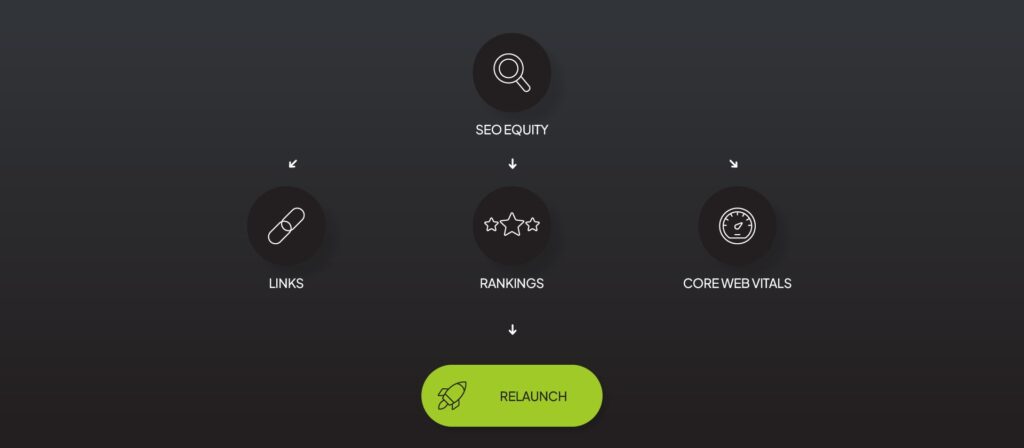
The mechanics of preventing a loss in equity are well understood:
- Build a complete URL inventory from your CMS, server logs, and backlink sources, and flag the pages carrying the most traffic and the strongest links.
- Map keyword and search intent to each old URL, so you know which content to merge, expand, or remove before anything moves.
- Map every old URL to one new target with a permanent 301 redirect, so link equity transfers instead of evaporating.
- Check your canonical signals so variants like HTTP and HTTPS or trailing slashes don’t split the equity.
- Carry your schema markup across, so structured data like FAQ or HowTo markup keeps your rich results intact.
- Check robots.txt and your meta robots tags so the new paths aren’t accidentally blocked from search.
- Take a ranking and Core Web Vitals snapshot before launch, so you have a true before and after.
- Crawl the staging site before go-live to catch redirect chains, broken status codes, and accidental blocking rules.
- Watch impressions and error codes in the first days after launch, with alert thresholds set in advance, so a problem surfaces in hours rather than in next quarter’s revenue report.
- Run a review against that snapshot 30 days after launch, and fix any redirects or content that missed the target.
This isn’t the most glamorous work, but it protects revenue. A relaunch that ships a beautiful new design but loses 15 percent of its organic traffic has a negative return, however good it looks.
Remember that the return compounds after go-live
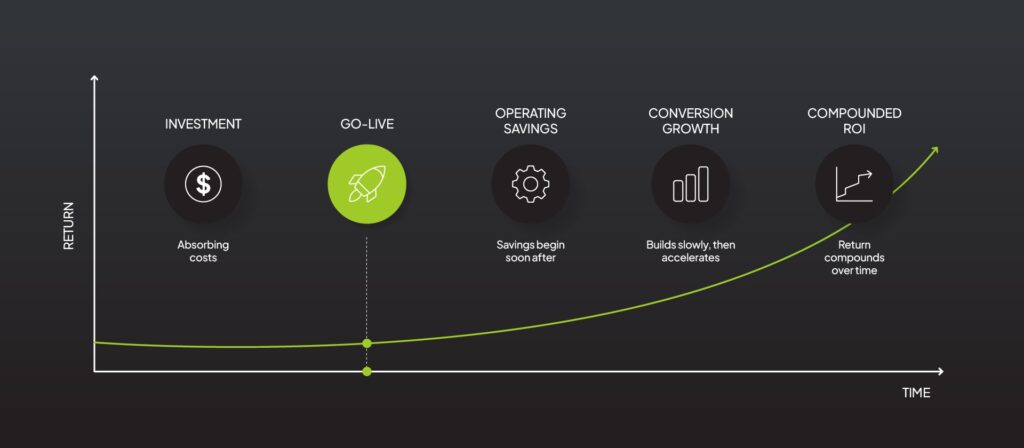
A relaunch starts a return that builds over time. The beginning is mostly about absorbing cost: design, development, migration, and the change management effort of training people and setting up governance. But operating savings come through soon after the legacy stack is retired. Revenue uplift from better conversion builds slowly at first, then accelerates as the new platform lets you ship improvements that were impossible before. For this reason, it’s important to judge the effectiveness of a relaunch over a longer period of time. It’s also why it’s so important to set the performance tracking goals and timelines well in advance, so no one loses their head when the brand new site doesn’t immediately double conversions on day one.
Optimization and testing habits help to reinforce and continue optimizing growth. Once the new site is stable, you can run monthly growth sprints against your conversion points using a simple feedback loop:
- Start with a clear hypothesis and a measurable target, such as a 5 percent lift in form submissions.
- Run a controlled test against that target.
- End with a documented decision to keep, drop, or retest, then feed the result into the next sprint.
Prioritize the backlog by impact and effort so the team works on the hypothesis most likely to move the number. Over a year, this turns a static asset into a repeatable system that improves on a schedule that’s trackable and easy to attribute.
Make ROI someone’s job. No, seriously.
Relaunch ROI tracking tends to slip through the cracks of functions, management, and departments. But that’s usually because the responsibility is split by default: The CTO owns performance, the CMO owns conversion and rankings, the CIO owns compliance and the audit trail, and the CEO owns the payback period. Each one is doing their job, but it’s uncoordinated, so each role ends up optimizing for its own metric while the combined return goes unmeasured, or starts to break apart. To see real, trackable ROI on your relaunch you need to understand that it’s all connected. Your compliance, conversions, performance, and governance are all part of the same system, and they should be treated as such. If nobody is accountable for connecting a faster page to a shorter payback, it’s going to take a lot longer to see the returns on your relaunch.
The connective tissue should be shared and visible:
- A single KPI scorecard that updates regularly, so the economic, technical, and governance numbers sit side by side and everyone reads from the same data.
- A redirect plan that’s reconciled with the compliance logs in advance, so protecting rankings and protecting auditability become one task with one goal instead of two competing ones.
- Growth experiments framed by expected pipeline impact, so a marketing test doubles as a sales forecast.
By connecting teams, results, and objectives across teams, your organization turns the return into a number the whole leadership team can see. The last thing you want is a relaunch where every function shows good results, but the overall platform shows poor returns. So make it someone’s job or responsibility to track performance and success metrics as a whole and in relation to each other. This will also keep teams aligned instead of fighting for their five minutes of fame when it comes time to present.
Teams that work this way stop having the annual argument about whether marketing isn’t doing enough for sales, or technical isn’t fast enough for marketing.
When you can clearly define what the returns of a relaunch should realistically be, build the project to deliver those returns, continually optimize for them, and measure it across departments the entire way through, you’ll be left with a relaunch that makes money and drives the business forward.
Planning a relaunch? Let’s get you the ROI you’re looking for.
We work with enterprises to plan and run website relaunches around the returns they aim for.
Websites & Relaunch: Full relaunch projects scoped around clear KPIs, from baselining and design through build and go-live, on a platform you own.
Content Migration: URL mapping, redirect strategies, metadata, and asset migration that protects your search equity.
Custom Integrations: Connect your new WordPress platform to your existing CRM, ERP, analytics stack, SSO, and MarTech tools, so the data behind your numbers stays clean.
Maintenance & Support: Centralised updates, security monitoring, and platform governance that keep your performance gains in place once you’re live.
Quality Assurance: Expert QA for your new installation, or a full audit of your existing platform before you decide what comes next.
Got some questions? Talk to our experts.
Turn your website relaunch
into a growth driver
— not just a redesign
With Syde, you combine the flexibility of open source with the reliability of enterprise delivery: strategy, technology, SEO, and continuous improvement in one roadmap.
Related posts
-

Why Choosing the Right CMS Can Make or Break Your Website
When it comes to building a website that actually works for your business, the CMS isn’t just another tool, it’s the backbone of the entire operation.
-

Product Owner Niklas Gutberlet
Syde’s open-source and people-centric mentality made me feel right at home from the very first contact.
-

Director of Engineering / Delivery Giuseppe Mazzapica
I was wearing my green Syde T-shirt already at my honeymoon in Thailand, and one year later I’m more than happy to be where I am.
Failed to submit:
one or more fields are invalid.