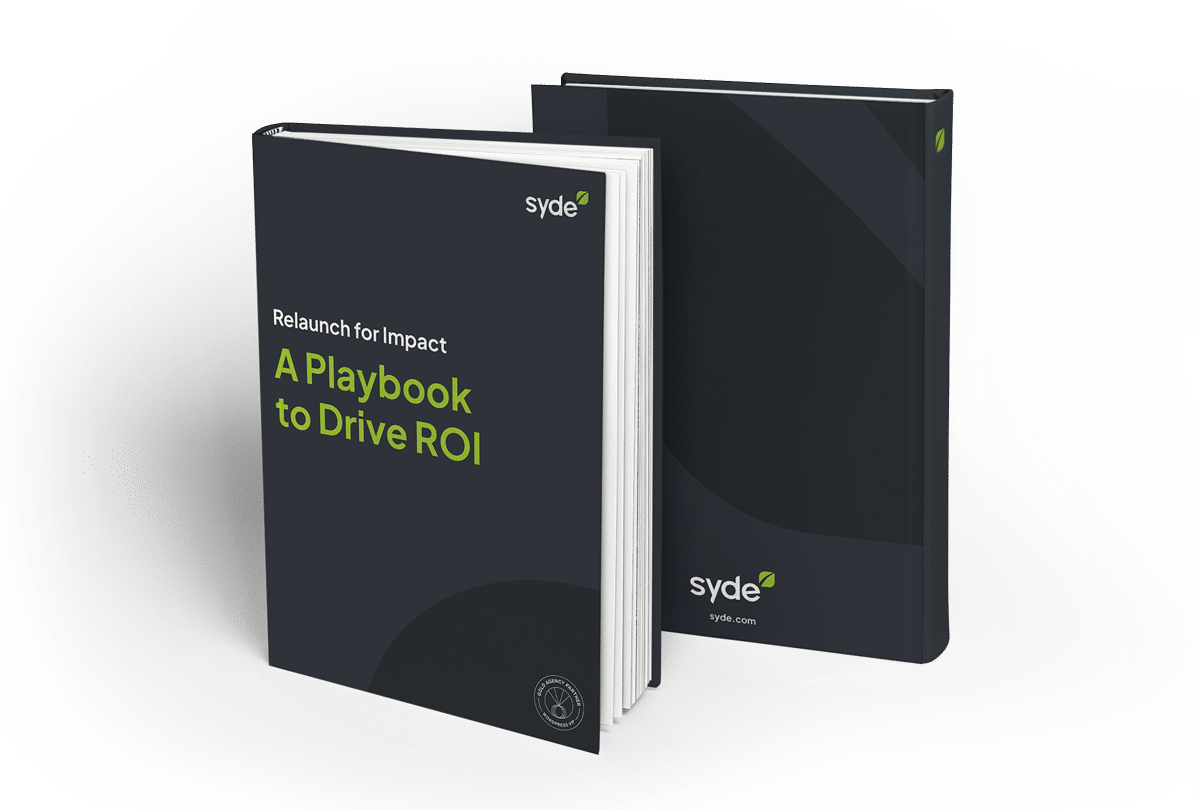
Your corporate website isn’t a brochure — it’s a growth platform. With Syde, a website relaunch becomes a measurable business initiative that accelerates revenue, boosts performance, and proves compliance across complex system landscapes.
Performance bottlenecks, outdated frameworks, and rising maintenance costs are the top reasons enterprises plan a website relaunch. Even a 100 ms slowdown in loading can materially reduce conversion — an effect that compounds at scale. A structured relaunch addresses these risks and sets explicit KPI targets for ROI, Core Web Vitals, and governance.
What leading Enterprises target
Economic Impact
Breakeven within 12 months by combining conversion uplift with lower operating costs.
Technical excellence
LCP P95 < 2 s for 95% of sessions, with predictable rollback windows.
Governance & compliance
Auditable releases, clear roles, and GDPR/ISO-aligned processes.
Be up to date: Generative AI, composable DXPs, and personalization only create value when your content, data layer, performance, and governance are in order. Without that foundation, AI pilots remain siloed, costs spike, and risks increase. A modern relaunch establishes structured data (Schema.org), clean APIs, Core Web Vitals at scale, consent & audit trails, and role-based access — the preconditions for sustainable AI use cases.
Fast AI Readiness Plan
(what we implement)
Identify canonical knowledge sources and expose them safely via API.
Inventory and structure content; strengthen schema and data layer.
Add AI checks to CI/CD (PII scanning, prompt tests, quality metrics).
Separate data access (public/internal/confidential) with retention rules.
Start with 2-3 high-impact use cases (e.g., support FAQs, internal editorial assistance) and measure resolution rate and satisfaction before expanding.
We use a proven 3-phase approach to keep uncertainty low and ROI measurable.
Phase 1
Before the Relaunch
Strategy & KPI Framework
Set explicit economic, technical, and governance goals, then validate current performance, risks, and resources. Establish a KPI triad (e.g., conversion rate, LCP, release cycle time) and define a governance model with roles and approvals.
What we deliver in Phase 1
Stakeholder interviews → KPI translation and risk matrix
Baseline for Core Web Vitals and operating costs
Content inventory and consolidation plan
Governance & compliance requirements (GDPR/ISO) and rollout cadence
Budget/timeframe validated against KPI targets
Phase 2
During the Relaunch
Control, Quality, Risk
Translate strategy into code and processes. Secure SEO rankings through a redirect matrix and structured migration, enforce CI/CD pipelines with automated tests and quality gates, and manage risks in real time with dashboards and a single source of truth risk matrix.
Phase 3
After the Relaunch
Monitoring, Optimization, Governance
Within the first 72 hours, verify stability every five minutes (Core Web Vitals, response codes, conversion). Then switch to monthly growth sprints and a quarterly governance board (security patches, audits, style guide updates, trend radar).
Automated build → test → stage → deploy with hard quality gates shortens time-to-value and reduces risk.
Examples: fail if >2% unit tests fail; prevent deployments if Lighthouse score drops beyond thresholds; enforce signed images and blue-green/canary with <5-minute rollback.
What we implement by default
Feature branches with reviewed pull requests
Static analysis, dependency scanning, and container signing
End-to-end and performance tests with LCP targets in pipeline gates
Change logs that tie commit, build number, test results, and deployment time for auditability
Performance guardrails (typical targets)
LCP (P95) ≤ 2,000 ms, INP (P95) ≤ 250 ms, TTFB (median) ≤ 400 ms, 5xx ≤ 0.3%, CPU (mean) ≤ 70% — validated via synthetic and real-user monitoring.
After Go-Live
72-Hour Verification → Continuous Growth
First 72 hours (5-minute interval): LCP median, response codes, conversion rate, funnel drop-offs with alert thresholds (e.g., LCP > 3,000 ms, 5xx > 0.3%). Pre-approved rollback path within 5 minutes.
Growth sprints (ICE scoring), A/B tests, heat maps, user interviews
Knowledge base of hypotheses, results, and lessons learned
Syde is a true leader in the WordPress ecosystem. Their dedication to quality of code and upholding the highest standards for WordPress development are evident in the solutions that they provide for their clients.
Ross Spadaro Agency Partner Manager – WooCommerce
Syde transformed our website, making complex tasks simple and fostering genuine collaboration. The forward-thinking and approachable team ensured a seamless process, truly valuing our partnership.
Martina Christen Comm. Officer, University of Luxembourg
It’s an honor to work alongside an agency that is so thoughtful and skilled. Getting to see this team in action in person and behind the scenes really gives you insight into the care and creativity they bring to each project.
Jodie Fiorenza Director Agency Partnerships, WordPress VIP
We at Eurotext have found a reliable and creative partner in Syde for more than 10 years now. Personally, I highly appreciate the friendly and uncomplicated cooperation at an exceptionally high technical level.
Boris Zielonka Director Business Development, Eurotext
I have been working with Syde for 4 years, and the partnership between our companies goes back 7 years. In that time I have found them to be an extremely professional and skilled agency, with a deep understanding of all things WordPress and WooCommerce. Beyond the headlines, the best thing about working with Syde is the people!
Ian Ferguson Senior Partner Manager, WP Engine
Working with Syde on this project was an outstanding experience. Their expertise, communication, and commitment to quality truly sets them apart.
Open source brings transparency, a global talent pool, and no vendor lock-in — with WordPress combining a massive ecosystem (60k+ plugins), headless capability, and optional SLAs (e.g., WordPress VIP). For organizations prioritizing scalability, innovation speed, and long-term cost efficiency, WordPress is often the most pragmatic core — without sacrificing enterprise reliability.
When to choose proprietary suites: tightly integrated marketing, fixed SLAs, strong authoring — but with higher license/upgrade costs and ecosystem dependence. We help you assess trade-offs objectively (TCO, lock-in, scalability, workflows).
Selected Results
Enterprise Proof
Headless WordPress VIP with CI/CD and global edge caching
LCP dropped from 3,200 ms → 1,450 ms
Operating costs −22%, +12% page views per visit
Live in all languages <60 seconds after approval
Multi-site migration (1,500+ pages) with a design system
TTFB improved 950 ms → 280 ms
Onboarding reduced from 5 days → 2 hours
Maintenance −30% via centralized updates and scanning
Syde is Europe’s biggest WordPress agency, focused on business-critical platforms for enterprises and upper mid-market. We combine technical excellence with measurable business outcomes.
100+
Enterprise relaunches worldwide
40+
Full-time specialists (dev, design, strategy)
99.98%
Average availability on-SLA-backend projects
+20%
Average conversion increase after go-live (selected projects, last 3 years)
How we work
Structured discovery (KPI mapping, risk analysis, PoCs), modular architectures, automated testing, CI/CD, and continuous optimization after launch.
Is Discovery just an expensive PowerPoint presentation?
No, our Discovery service is an intensive, methodical analysis and planning process in which we work with you to develop concrete and reliable project results. The result is a detailed Project Requirements Document (PRD) and not a superficial set of slides.
Why not develop directly?
Without a well-founded requirements analysis, you risk expensive undesirable developments, technical dead ends or misunderstandings between the teams. Discovery ensures predictability, cost control and clear responsibilities before implementation begins.
Is the discovery service tied to a later implementation at Syde?
No, you can also use the result of the discovery as a basis for offers from other service providers. If you decide to implement your project with Syde, we will generally offset part of the discovery costs against the subsequent project.
How long does a discovery take?
Depending on the size and complexity of the project, a discovery usually takes between 2 and 4 weeks. During this time, we conduct workshops, analyze requirements and create the PRD.
Who should take part from the customer side?
Ideally, all relevant stakeholders should take part. Typically, these are representatives from marketing, IT, product management and other specialist departments. It is important that everyone who will later make requirements or decisions is involved at an early stage.
Is there a rough price guide?
The costs for a discovery service vary depending on the scope and complexity of the project, but generally start in the lower five-figure euro range. In an initial discussion, we clarify together which setup is sensible and necessary for your project.
Turn your website relaunch into a growth driver
— not just a redesign
With Syde, you combine the flexibility of open source with the reliability of enterprise delivery: strategy, technology, SEO, and continuous improvement in one roadmap.
You are currently viewing a placeholder content from Facebook. To access the actual content, click the button below. Please note that doing so will share data with third-party providers.