
Most WordPress sites already recommend content in some form. There is usually a related posts block under each article, a list of popular pages in a sidebar, and a few links an editor added by hand. These tools work while a site has a few hundred pages and one team looking after them. But when the content library grows faster than anyone can curate it, manual link-building and suggestions can cause most of your content to go unseen.
AI recommendations are useful in filling that gap, and they add clear value in four specific areas of a website to make finding content and material easier and more beneficial for visitors.
AI recommendations can bring older content back in large website archives
Let’s take a quick look at publishers and universities. In most cases, these organizations can sit on years of content. A lot of the content may still answer the questions people search for and add value to new visitors, however, if that content is impossible to find, your site may end up directing queries to the same handful of articles or pages. This is where AI becomes a powerful tool to create more value for your website visitors.
Built-in AI recommendations read the content itself and match articles on meaning, rather than simply recommending an article or page based on the tags that were used. An explainer from three years ago can appear next to this week’s news when both cover the same subject, even if an editor tagged them differently. This creates more relevance for readers and visitors. And it also means that old pages can still be useful to your website. Your archive goes back to work, and every article gives the reader a relevant next page.
AI can provide suggestions for internal links and tags in the WordPress editor
For editorial teams, the most direct advantage they gain from implementing AI suggestions is in the editor. An AI tool can suggest internal links, tags and categories as an editor writes, giving more depth and substance to an article. On a large site, nobody would be able to remember every article that relates to the one in front of them, so links get missed and tags can start to drift. AI suggestions in the editor catch those misses before the article goes live and allow the editor, or editing team, to build a more comprehensive piece of content, without them needing to manually search pages or archives of past content.
Of course, the editor still gets to decide what goes into the page and what to ignore. But by having a tool to scour your site for you, editors can save heaps of time and effort and use the extra time to focus on building a better piece of content. This also improves every other recommendation on the site, because consistent tags and links give the system better material to work from.
AI recommendations work across multinational and multi-brand networks
In a WordPress multisite network, each brand or market usually runs its own site with its own team and its own tagging habits. Useful content on one site stays invisible to readers and editors on the others. However, with AI recommendations, teams can match relevant content across the whole network and across languages, so relevant material from one site can surface on another within the rules you define. Content teams can decide which sites share content and which stay separate.
Central teams gain a second benefit with this kind of setup. The same matching shows where brands have published near duplicate articles on the same topic, which makes it easier to consolidate content and keep messaging consistent across the network.
Personalised AI recommendations for signed in WordPress users
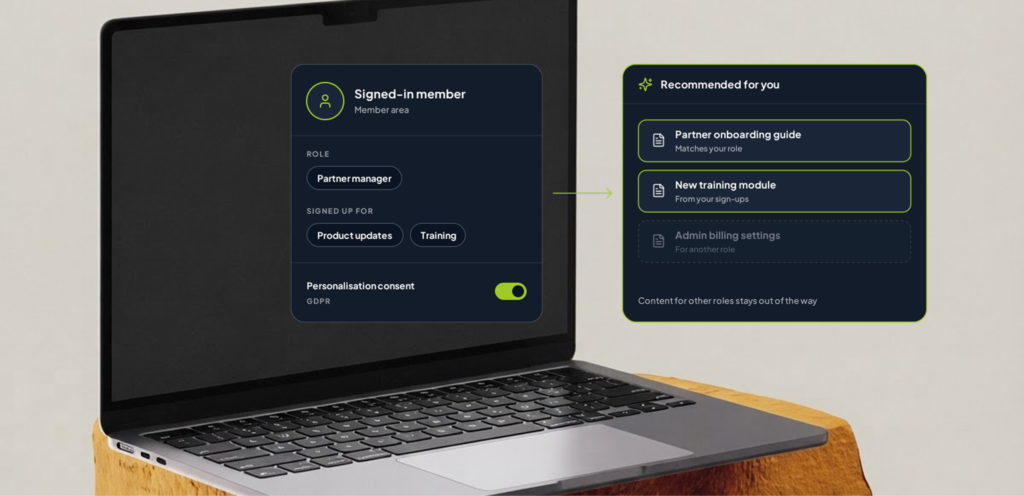
Member areas and customer portals give you additional context that a public site lacks. You know the user’s role and what they signed up for. Recommendations based on that context can help people find what applies to them faster and easier, and without searching through content meant for someone else.
It’s important to note that personalisation based on behaviour must have a clear consent setup under GDPR.
When does a site not need AI content recommendations?
A site with a few hundred pages and one editorial team rarely needs them. Manual curation works at a smaller size, and an AI layer can add costs and additional maintenance that a smaller team might not be able to manage. The same goes for sites where content changes rarely, since a hand picked set of links stays accurate for a long time.
Regulated content needs care too. In pharma and financial services, every link a reader sees often needs approval, so recommendations should draw only from approved content or stay as suggestions for editors to review. This can be built into your AI tooling system and review parameters. However if this step is skipped, it can cause compliance issues across a site that’s using AI recommendations ungoverned.
Data handling also requires attention and curation early on. Many AI recommendation services process your content on external infrastructure. For European organisations, that means checking where the data goes and whether it fits your data residency and privacy requirements before anything goes live. Compliance can never take a beat seat to AI implementations. Which is also why AI tools need to be implemented with compliance in mind from the beginning, and not haphazardly.

Why taxonomy and content structure decide the quality of AI recommendations
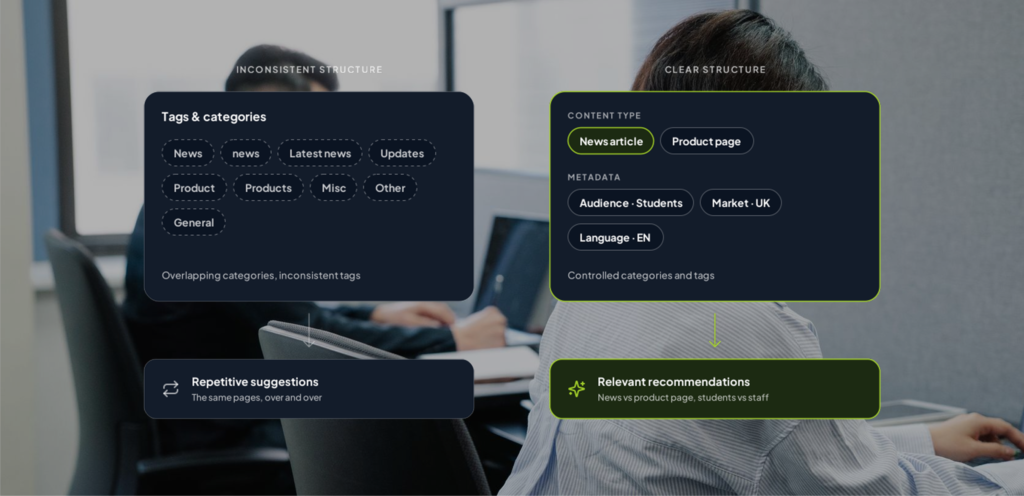
AI recommends from what it can read and what it has access to. Your content model, taxonomy and metadata shape every suggestion the AI tools can make. A site with overlapping categories and inconsistent tags can run into repetition problems if the tooling isn’t set up correctly.
Good structure and governance gives the AI clear signals to work with. That means having content types that reflect what each piece actually is, a controlled set of categories and tags, and consistent metadata for details like audience, market and language. With that in place, recommendations can tell a news article from a product page, or content for students from content for staff. And your AI tools can become more effective at recommending more relevant content to website visitors and users.
By cleaning up the taxonomy and content models first, that gives the AI tooling clear signals. The editor suggestions then help keep that structure clean as your team publishes, so the recommendations hold their quality as the site grows. Your readers find the right next page, and the content you have already paid for keeps reaching the people it was written for.
If you’d like to find out how we implement AI tools to empower enterprise teams to do more with WordPress, click here.
Failed to submit:
one or more fields are invalid.